How to Validate an App Idea Before You Build
To validate an app idea, prove three things before you pay for development: a specific group of people has a painful problem, they’re already trying to solve it, and they’ll commit (with an email, their time or their money) to your solution. You can do it in days to a few weeks, mostly without code.
- Name the user and the one problem. Vague ideas can’t be validated.
- Talk to 10–15 target users about their past, not your idea.
- Run a cheap demand test: waitlist, fake door or pre-sell.
- Check competitors and workarounds. Both are good news if handled right.
- Decide: go, pivot or stop. Then use the scorecard below.
I have an app idea, now what? Don’t hire a developer yet. Spend a week or two collecting evidence first. It’s the cheapest part of the whole journey.
1Do the problem check
Write one sentence: “[Who] struggles with [problem] when [situation].” If you can’t, the idea isn’t ready to test yet.
“Mobile dog groomers”, not “pet owners”.
It costs them time, money or stress, regularly.
Weekly problems beat once-a-year ones.
2Talk to 10–15 target users
Not friends, not family: people who match your one-sentence user. Ask about what they’ve actually done, not what they might do. People are kind about hypotheticals and honest about their past.
“Tell me about the last time this happened.”
“How do you handle it today?”
“What have you tried? What did it cost?”
“Who else should I talk to?”
“Would you use an app that…?”
“Do you like my idea?”
“How much would you pay?” (asked out of the blue)
Pitching for 20 minutes.
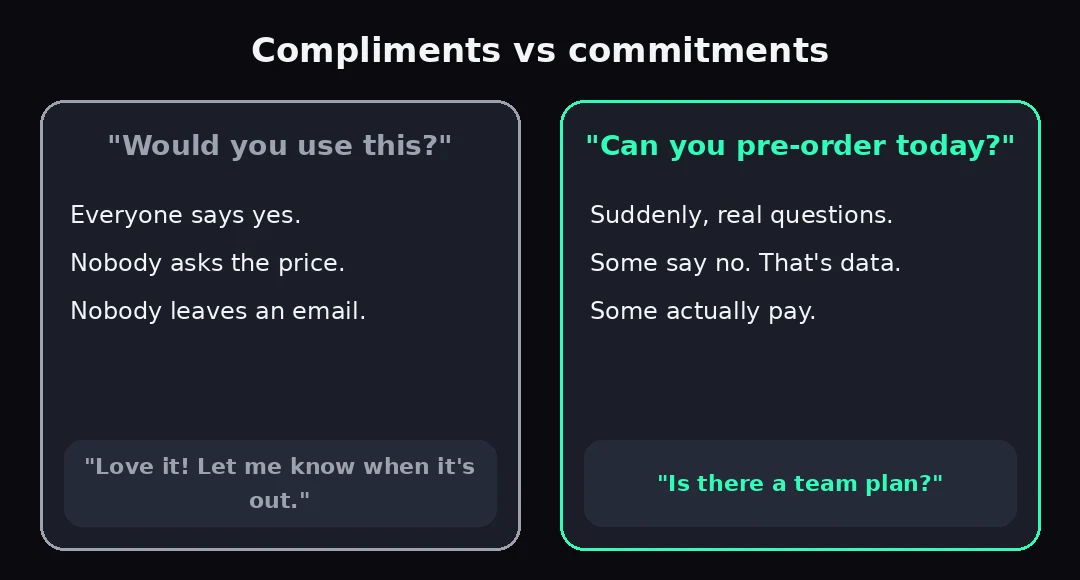
3Test demand with something people can commit to
One page: the problem, your promise, an email sign-up. Send your target users to it.
Offer early access or a founding price. A payment (even refundable) is the strongest signal there is.
Deliver the result by hand (spreadsheets, messages, phone calls) for a few customers before automating it.
4Check competitors and workarounds
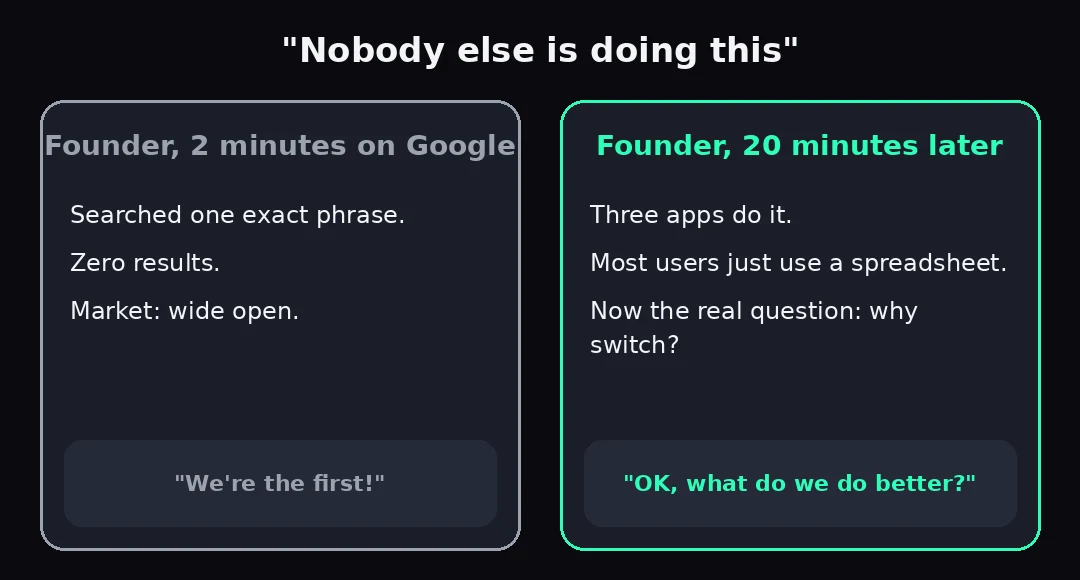
Search app stores, Google and forums for how people solve this today. Finding competitors usually means the problem is real. The question becomes why would someone switch? Workarounds such as spreadsheets, group chats and paper forms are even better news: proof of pain with no good product yet.
5Try a fake door or a clickable prototype
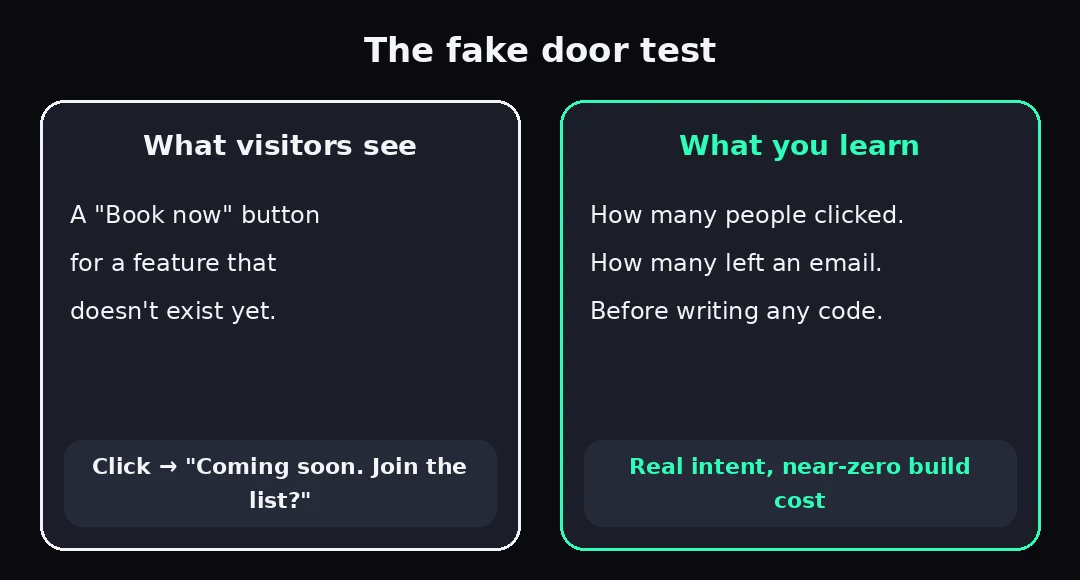
A fake-door test puts a real button (“Book now”, “Start free trial”) in front of people for a feature that doesn’t exist yet, then explains it’s coming and asks for an email. A clickable prototype (design screens linked together) lets users try the flow so you can watch where they get stuck. Neither needs production code.
Want to know how a prototype differs from a real first version? Our guide to MVP development covers it.
6Decide: go, pivot or stop
Set your bar before you start (for example, “a set number of strangers join the waitlist in two weeks”), then judge the results against it, not your hopes.
📋 App Idea Scorecard
Rate each from 1 to 5. Be honest: nobody’s watching.
50
Score each question from 1 to 5:
- How painful is the problem? 1 = mild annoyance, 5 = costs them time or money every week
- How often does it happen? 1 = once a year, 5 = daily
- Who pays, and will they? 1 = no idea who pays, 5 = a clear buyer with budget
- Are people already hacking a workaround? 1 = no, 5 = spreadsheets, paper, duct tape everywhere
- How easily can you reach these users? 1 = no idea where they are, 5 = you can message 20 tomorrow
- How many target users have you spoken to? 1 = none, 5 = ten or more, outside friends and family
- What did your demand test show? 1 = no test yet, 5 = sign-ups or pre-orders from strangers
- Can you describe the core job in one sentence? 1 = it does lots of things, 5 = one user, one job, crystal clear
Add them up (8–40). Under 22: validate more. 22–31: build a prototype or fake door. 32 or more: you’re ready to scope an MVP Sprint.
Common validation mistakes
- Only asking friends and family. They love you, not necessarily your idea.
- Pitching instead of listening. If you talk most of the call, you learned little.
- Counting compliments as demand. Only commitments count.
- Testing a vague audience. “Everyone” can’t be reached or tested.
- Moving the goalposts. Decide what success looks like before the test.
- Validating forever. At some point, a focused MVP is the next best test.
What validation does (and doesn’t) prove
The problem is real, who has it, how they solve it now, and whether they’ll commit.
That people will keep using your app, that the business model works at scale, or that you’ll beat competitors. Only a live product answers those.
When are you ready for an MVP Sprint?
You’re ready to build when you can tick these off:
- You can name the user and core job in one sentence.
- Several target users described the problem without prompting.
- Strangers committed: sign-ups, intros, pre-orders.
- Your must-have feature list fits on one page.
Next, read how to make an app without a tech team for your build options, and how MVP development works for scope, timelines and cost. GoLive’s fixed-price MVP Sprint is about $35k (AUD, including GST), with a typical 4–8 week build.
Got evidence? Let’s scope your MVP.
GoLive Apps builds MVPs for founders with no tech team: human + AI developers, fixed-price sprints, launch in 4–8 weeks, and the source code is yours at handover.
Frequently asked questions
How do I validate an app idea?
Check that a specific group of people has a painful problem, talk to 10 to 15 of them about how they handle it today, then test demand with something they can commit to, like a waitlist, a pre-order or a fake-door button, before you build.
How long does app idea validation take?
Usually days to a few weeks, not months. A round of user conversations and a simple landing page test can be done in one to two weeks if you can reach your target users.
Can I validate an app idea without building anything?
Yes. Conversations, landing pages, waitlists, pre-sales, fake-door tests and clickable prototypes all test demand without writing production code.
What is the difference between validating an idea and building an MVP?
Validation tests whether the problem and demand are real. An MVP is a working product that tests whether your solution keeps real users coming back. Validate first, then build the MVP.
I have an app idea, now what?
Write down who it is for and the one problem it solves, talk to people who have that problem, and run one cheap demand test. If the signals are strong, scope a focused MVP.
Related: How to make an app without a tech team · MVP development: ship your first app in weeks