MVP Development: How to Ship Your First App in Weeks
MVP development means building the smallest version of your app that real users can use to solve one real problem, so you learn what to build next before you spend your whole budget. Done well, a focused MVP can go from scope to launch in about 4 to 8 weeks.
- An MVP is a real, live product with a deliberately small scope.
- Start from one user and one job, then cut.
- A tight MVP: about 4–8 weeks of build.
- GoLive MVP Sprint: about $35k, fixed price (AUD incl. GST).
- Plan version two from what users actually do.
Most wasted money in app projects isn’t on bad code. It’s on good code for features nobody needed yet.
1What is an MVP, really?
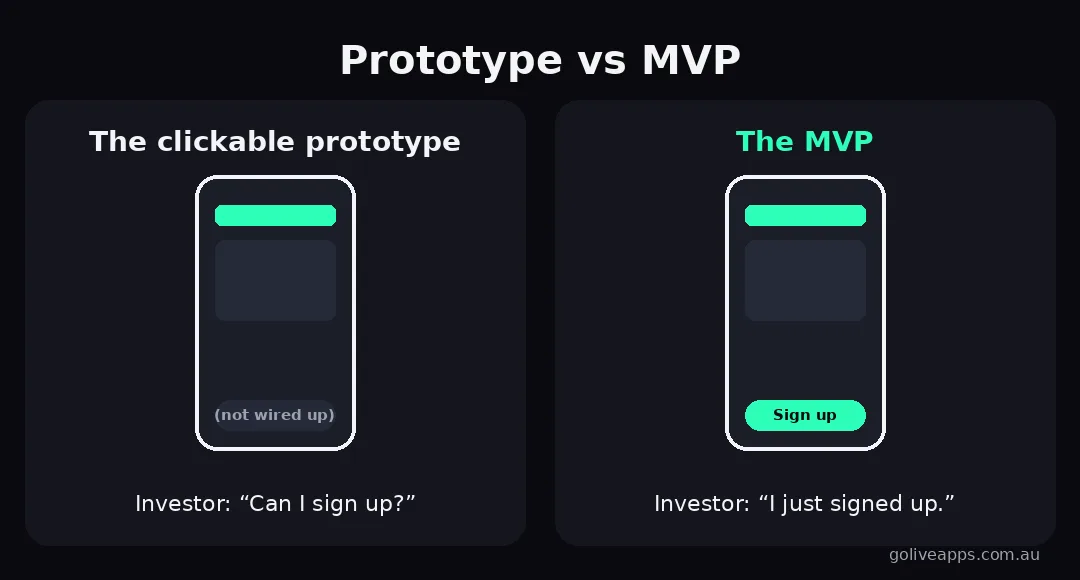
Not a demo, a mock-up or a cheap version of your dream app. A real, working product with a deliberately small scope.
Only the features the core job needs.
Good enough that people use it, and ideally pay.
Live, in users’ hands, collecting real feedback.
2Why build an MVP instead of the full app?
Because your first plan is a guess. An MVP lets you:
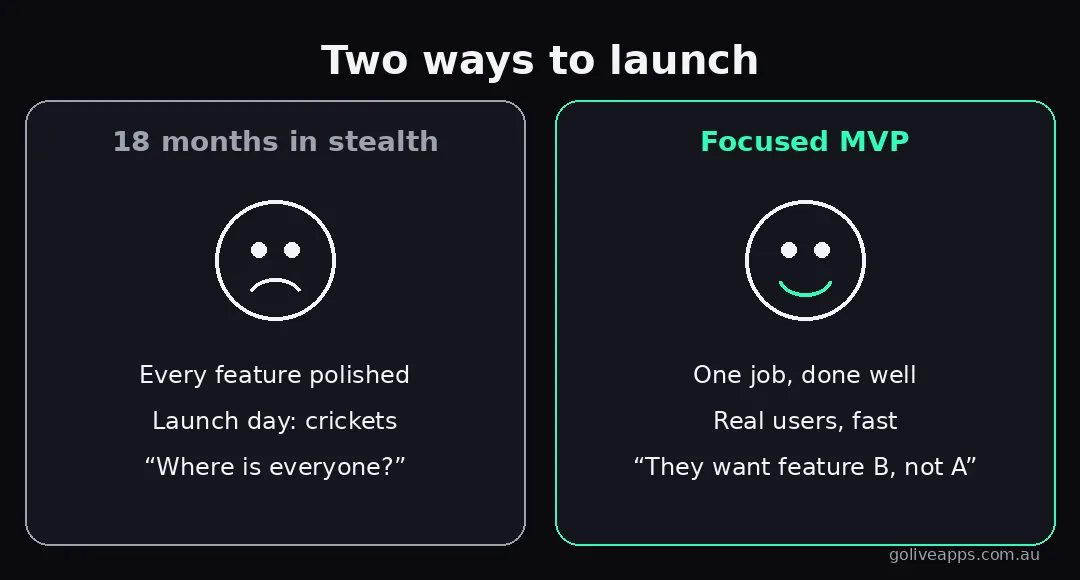
Find out if people want it before funding every feature.
Matters if you’re raising or chasing a season.
Version two comes from what users did, not what you assumed.
Investors want usage, not slides.
3What features should your MVP include?
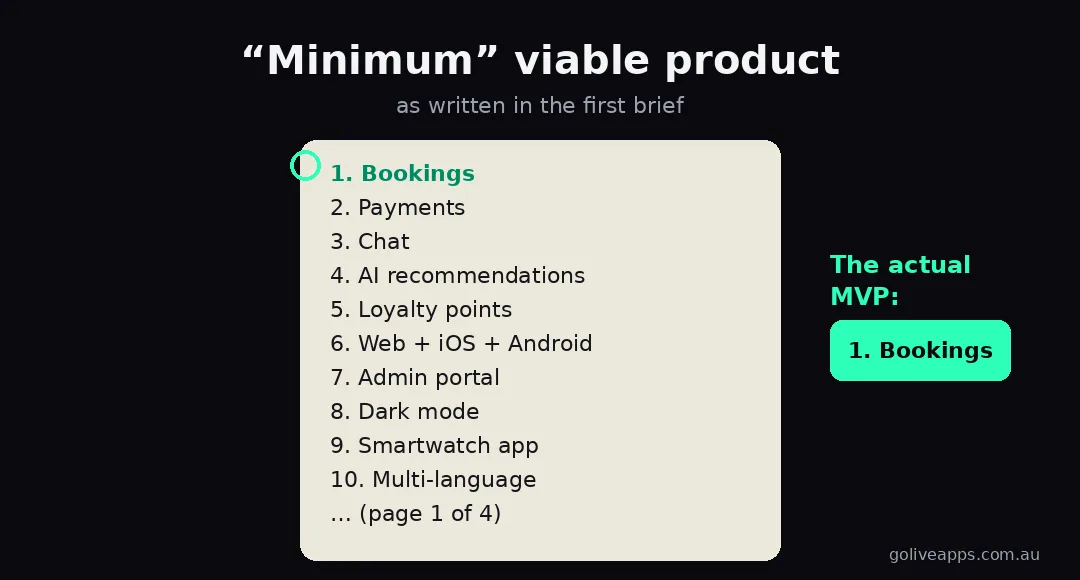
Start from one user and one job, ideally one you’ve already checked with real users (here’s how to validate an app idea). Then cut.
- Write the core job in one sentence. E.g. “A tradie can send a quote from their phone in under two minutes.”
- List every feature you’ve imagined.
- Mark each: must-have, nice-to-have or later. A must-have is something the core job can’t happen without.
- Keep the must-haves. Be ruthless. Logins, the core flow and basic payments are usually in. Dashboards, chat, referral schemes and multiple user roles usually aren’t.
🧪 Is this feature MVP? (3-question checker)
Think of one feature you’re unsure about, then answer honestly.
Answer all three to get a verdict.
Rule of thumb: if the core job works without it, or a manual workaround covers it, it goes on the “later” list.
4How long does MVP development take?
For a tightly scoped MVP, about 4–8 weeks of build is realistic.
| Phase | What happens | Typical length |
|---|---|---|
| Scope | Agree the core job, user flows and must-haves; fix the price | Before the build starts |
| Design | Key screens and flows, reviewed with you | First 1 to 2 weeks |
| Build | Weekly demos so you see real progress | The bulk of the sprint |
| Deploy | App store submission, web launch, handover | Final week |
What stretches timelines: changing scope mid-build, slow feedback, and third-party integrations nobody tested early.
5How much does MVP development cost?
It depends on scope, platforms (web, iPhone, Android) and integrations. Our published GoLive Apps packages:
- MVP Sprint: about $35k, fixed price
- Full Build: $55k to $85k for bigger products
- Enterprise: 8+ weeks of work
Quotes elsewhere vary widely, so compare what’s included: design, testing, app store submission, support after launch and code ownership.
US$99 a year, per Apple (as of Nov 2026).
US$25 one-time, per Google’s Play Console help (as of Nov 2026).
Small at launch, grows with users.
Doing genuinely new technical work? Some Australian companies look at the R&D Tax Incentive. Eligibility is strict and most standard app builds won’t qualify, so get advice from a registered tax agent first.
6Fixed price or hourly: which is better for an MVP?
Cost known up front, scope written down. Changes go through a change request.
Flexible, but the budget risk is yours, and progress is hard to judge without tech knowledge.
Either way, insist on a written scope, weekly demos, and full ownership of the source code.
🚦 Is your idea MVP-ready?
Tick everything that’s true today.
Tick what applies to see where you stand.
Four or five ticks? You’re ready to scope. Fewer? Start with how to make an app without a tech team.
7How does AI change MVP development?
AI coding tools help experienced developers write, test and refactor code faster, which can shorten build time and cost. They don’t replace product decisions, security reviews or someone who knows what “done” looks like.
The useful model: human developers using AI, with a person accountable for every line that ships.
That’s how GoLive Apps works: human developers using AI tools such as Claude, on a mainstream stack (React Native, Next.js and Supabase) so any developer can take over the code later.
8What should you do after your MVP launches?
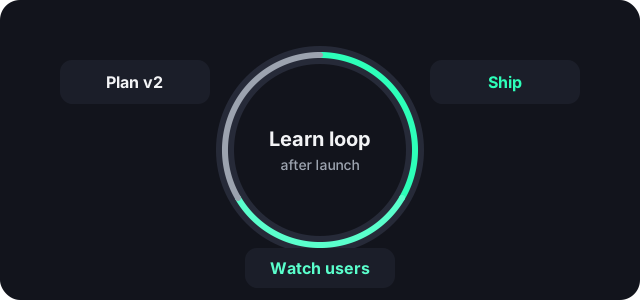
- Watch what users do, not just what they say.
- Track the one number you picked as success.
- Talk to your first 20 users. Ask what nearly stopped them.
- Plan version two from the evidence, then scope the next sprint.
New to all this? Start with how to make an app without a tech team.
Ready to scope your MVP?
GoLive Apps builds MVPs for founders with no tech team: human + AI developers, fixed-price sprints, launch in 4–8 weeks, and the full source code is yours at handover.
Frequently asked questions
What does MVP mean in app development?
MVP stands for minimum viable product: the smallest working version of an app that real users can use to solve one core problem, so you can learn what to build next.
How long does it take to build an MVP?
A tightly scoped MVP usually takes about 4 to 8 weeks of build time. Scope changes, slow feedback and complex integrations are the usual reasons it takes longer.
How much does MVP development cost in Australia?
It depends on scope, platforms and integrations. GoLive Apps publishes a fixed-price MVP Sprint at about $35k (AUD, including GST). Also budget for developer accounts, hosting and post-launch updates.
Is an MVP the same as a prototype?
No. A prototype shows how an app could look and feel. An MVP is a live, working product that real users use, so you can test the business, not just the design.
Can AI build my MVP for me?
AI app builders can make simple prototypes. For a production MVP, AI works best as a tool for experienced developers who stay responsible for product decisions, security and quality.
Related: How to make an app without a tech team · GoLive Apps home